Search

Rigg's Cabinet of Curiosities

Judging a Book by its Cover : Favourite Designs of 2016

I’ve been blogging for just about a year now and, during this time, I am gradually appreciating just how important the cover designs are and just how much thought goes into each one.   So I thought I’d take a moment to celebrate some of the truly brilliant covers that have passed through my hands.  My favourites complement their novel’s theme and genre whilst creating a stand out design to attract the browsing customer.

In no particular order, my top five are:

Beetle Boy by  M.G. Leonard.  These gorgeous illustrations are by Barcelona illustrator, Julia Sarda Portabella.  A link to her website is here.  I love the whole joie de vivre of the concept including the fore edge decoration – which is an added bonus.

Nevernight by Jay Kristoff.   The UK cover was designed by Cherie Chapman from the Harper Fiction team featuring an illustration by Philippines-based artist, Kerby Rosanes; it’s absolutely brilliant.  A real asset to the novel.  Here’s a link to Jay’s blog post where Cherie describes the design process.  I think it is so much better than the US design.

Blade and Bone by Catherine Johnson.   I loved this cover with its old engraving style and the clever use of colour to create a Tricolour impression.  The wonderful illustrator is Royston Knipe.  His website is here.

Cogheart by Peter Bunzl.   With Peter’s visual background in animation, it’s not surprising that the book has a great cover created by Kath Millichope, Fiction Designer at Usbourne.  There’s a lovely post by Middle Grade Strikes Back which includes an interview by Kath and the design animated by Peter.  The illustrations are by a wonderful American artist,  Becca Stadtlander.  Her work really enhances the story.  You can see more of it here.

The Goblin Emperor by Katherine Addison. I thought, on first picking it up, this was an old Fifties style design.  Of course, it’s a stylish remake by the Italian twin sisters, Anna and Elena Balbusso.  Their website is here.

The Pen Museum

… quirky little gem of a museum …

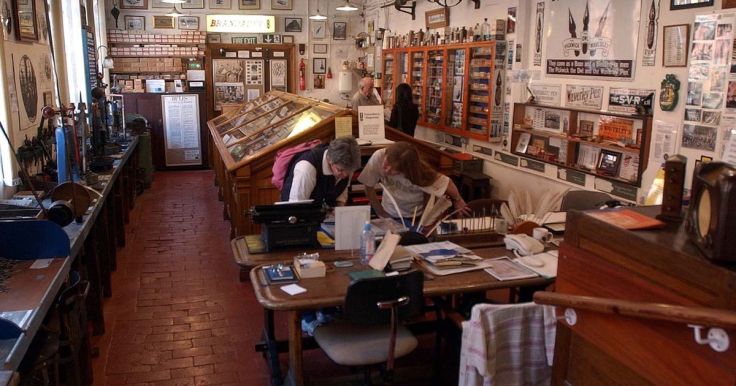
pen-museumA quirky little gem of Birmingham’s industrial history, the Pen museum is a small museum in the Jewellery Quarter run by volunteers.  It is about to re-launch after a Heritage Lottery grant,  however when I visited as many  exhibits as possible seemed to be crammed into one room.  It gave the impression of a rather dusty but fascinating sweet shop.img_1870

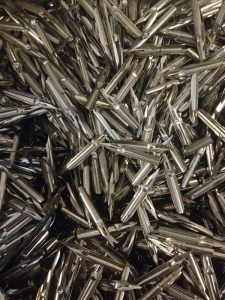
Based in a former pen factory , the museum celebrates the pen trade during the 1800s, and the lives of the manufacturers and workers whose expertise placed Birmingham at the centre of this worldwide trade.  A guide showed us how a steel “pen” (the nib) was made: stamped, cut and rolled using traditional machinery.  During my visit I learnt that in the 19th Century, 75% of everything written across the world was with a ‘Birmingham’ pen.  At one time, there were around 100 factories in the Jewellery Quarter area. The development of the steel pen reduced the cost of writing and enabled the spread of literacy throughout the world.

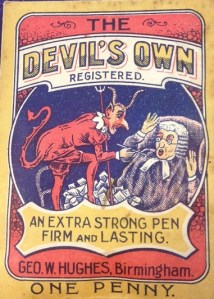
The museum also houses a range of objects associated with the pen trade and the history of writing, including inkwells, escritoires and period retail packaging from all over the world.nibpacket

Well worth an hour of your time.  For further information about the museum and news of their re-launch, visit their website here : penmuseum.org.uk


Blade and Bone : Catherine Johnson

… a thrilling adventure set in Revolutionary Paris …

9781406341874In this sequel to Sawbones (published in 2013), Catherine moves her characters from c18th England to c18th France and we follow the young surgeon, Ezra McAdam, to Revolutionary Paris.  Here, the English are the enemy and Citizen Renaud is anxious to involve Ezra in his reanimation experiments for which the “National Razor” is creating a steady supply.

In this dangerous city of harsh poverty and unpredictable violence, can Ezra find and rescue his friends: the impetuous Loveday and high handed Prince Mahmoud?

Blade and Bone is a thrilling adventure involving complex, believable characters with an intriguing background of c18th fact.  Catherine has a lightness of touch and she deploys her considerable knowledge to colour the story without weighing down the narrative.  I particularly enjoyed the dashing Lieutenant Colonel Dumas  of the American Regiment – a  real person and, as Catherine explains in her epilogue, still today the highest ranking soldier of African descent in any European army.  She has written more detail about the man here, in The History Girls blog.

Highly recommended.

Cover design moment: I loved this cover with its old engraving style and the clever use of colour to create a Tricolour impression.  The wonderful illustrator  is Royston Knipe.  His website is here.

Blade and Bone was published on 6 October 2016 by Walker Books.  

The Essex House Press : Court Barn Museum

… beautiful display of Fine Press illustration …

download-3

This is the third in a series of exhibitions celebrating CR Ashbee and the Court Barn’s collection of Essex House Press books.  The press was started by the arts and crafts designer and architect, CR Ashbee, in 1898 after he took over some of the staff and equipment of William Morris’s  Kelmscott Press which was then closing down.

Like other Private Presses of the time, the Essex House Press was dedicated to fine hand printing in the face of the growing mechanisation of publishing.   Between 1898 and 1910 the Essex House Press produced more than 70 titles with some truly beautiful illustrations, some of which are featured in this lovely little exhibition.

Some of my favourites are here including Paul Woodroffe’s  1906 Frontispiece to duchessThe Flight of the Duchess by Robert Browning.

So, if you are in the North Cotswolds, do check out this wonderful little arts and crafts museum in Chipping Campden.  The exhibition runs until the end of November and the Court Barn’s website for further information is here.

Jonathan Dark : AK Benedict

… captivating supernatural crime thriller …

isbn9781409144557-detail

Emily, my excellent bookseller, thought I might like this … and I was dubious as I’m more of an urban fantasy girl myself.  But, what a read!  This book is written in the present tense balancing the supernatural world of ghosts with the growing tension of a stalker about to pounce.  Its charm builds slowly as the book starts with a boiler plate policeman, DI Dark, who is nursing a broken marriage and a serious drink problem – so what’s new?  Well, quite a lot as it turns out.

AK Benedict deftly plays her stock characters and various strands: a blind mudlark, a vengeful spirit, a psychic funeral director, a criminal ring, and a taxi driving ghost around the main plot of a stalker planning to take his next victim.  DI Dark has already failed to catch this stalker and a miasma of desperation and grief hangs around this story of murder victims, brutal coercion and fading ghosts.  This is lightened by believable characters that linger long after you’ve stopped reading and a truly wonderful and intriguing Maria, the object of the stalker’s desire: “I’m a stalkee.  He’s not MY stalker.”; and her guide dog, Billy who huffs.

AK Benedict also has great fun scattering potential candidates for the stalker liberally around the story : is it Denver, the computer whizz, or Martin, the would-be boyfriend or some one else in the Force?  My mind started to jump with the possibilities.

This is a captivating supernatural crime thriller.  I was rooting for DI Dark and Maria all the way and do I hope they return sometime soon.

AK Benedict lives in Hastings and writes in a room filled with teapots and the severed head of a ventriloquist’s dummy.  Her debut novelThe Beauty of Murder, was shortlisted for an eDunnit award and is in development for an 8-part TV series. Her audio drama, The Victorian Age, was released as part of the Torchwood range at Big Finish while Outbreak, a full-cast Torchwood audio co-written with Guy Adams and Emma Reeves, will be released in November 2016.

Cover design moment: The designer of the smart UK cover is credited in AK’s blog.  He is the lovely Patrick Knowles who is responsible for the hand lettering and cover design for Ben Aaronovitch‘s Rivers of London series.

Jonathan Dark was published in February 2016 by Orion Books.  I was given a proof copy by A Festival of Books.  Thanks, Em!

Chasing Embers : James Bennett

… enjoyable urban fantasy with a dragon’s twist … 

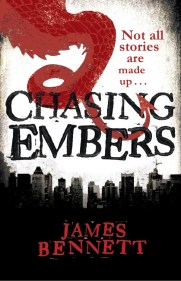
Chasing-Embers-final-visual-600x934.jpgThis has a great protagonist, Red Ben Garston, and a mix of satisfying story ideas drawn from myth.  The story is fun, however some of James‘ more florid descriptions stopped me dead as I tried to figure them out.   I do remember some brilliant images though: a wizened witch’s lips being described as a “fish bone” DOES work!

I felt James deserved a better editor as there was too much back story slowing the pace and a whole chunk of substory (about 16 pages) which really should have been excised.

I’m sure the editing will improve and I’m definitely enough curious to read the next in the series … when it arrives.

Cover design moment: The first class UK cover design is by Tracy Winwood who may (or may not) be a British designer based in Winchester.  The internet search I did on her brought up next to nothing.  This is a shame as I thought her design is distinctive and has lots of legroom for development in a Ben Garston series.

Chasing Embers was published on 8 September 2016 by Orbit Books.  I was given a review copy by A Festival of Books.  Thanks, Em!


Fated : Benedict Jacka

… a diviner with a troubling past and a dangerous future … 

fated-jacka-300x473

Alex Verus is the owner of Arcana Emporium, a shop in Camden Town, North London. He’s also a diviner with a troubling past and a dangerous future with a sort of cursed girlfriend and a habit of not taking sides.   Alex gets dragged into the middle of a treasure hunt with Dark and Light mages competing for an ancient prize hidden in the British Museum: a fateweaver, a wand that can control the future.    Ghosts from Alex’s teenage years come back to haunt him – and kill him – as he tries to protect the ones he loves and hold himself apart from the deadly competitors’ claims on his loyalty.

Benedict weaves a thoroughly enjoyable story with a likeable and damaged hero through to a thrilling and very well constructed end.  I would say there’s slightly too much explanation which began to slow the pace down, but I’m guessing Benedict’s writing can only get better.

A great addition to any urban fantasy shelf and, as Fated is the first in a series of seven, I look forward to reading more …

Cover design moment: The UK covers for at least the first couple in the series are by Sian Wilson. She is currently a Senior Designer at Simon and Schuster .  They really are good which is just as well as they have to compete with the urban fantasy bestseller, Ben Aaronovitch‘s, gorgeous covers based on a work by Stephen Walter. 

Fated was published by Orbit in March 2012.  I came across the book as the first chapter was printed in the back of  Chasing Embers by James Bennett.


Argh : where’s your red pen?

I don’t post a review of every book I read.  Why?  I am not a professional reviewer so I’m not obliged to file copy;  and because this site is about celebrating good books not criticising the three stars and below.  However, if anyone is interested, here are the top five faults which stop me recommending a novel I have read or have attempted to read.

  1. Indulgent world building.  It’s like sitting next to an enthusiastic bore. I love your world.  Really I do.  I just don’t need that much of it, thank you.  I want the story.  And my own space to imagine and have fun on my own.  Go away.
  2. Jumping Po470acd1c55ec9b862106a42efd5ea110int of View.  You want me to get travel sickness?  Just jerk me from character to character.  In the same scene.  In the same chapter.  It’s like pinball.  Where’s your empathy?  Try reading it as if it were your first time.
  3. Too many adverbs, she added menacingly.  Stop putting your dirty, annoying, nudge-nudge paw prints all over my reading experience.  Trust your writing will suggest more than the words written on the page.
  4. And here we come to Point Four in my List of Things That Irritate My Reading Experience just in case you haven’t guessed and need it spelt out,  Exposition.  Take out as much as explanation as you dare.  I can work out what’s going on from the merest trace.  I’m a social animal, I’m trained to pick up nuances and hints, and as I am reading a book, it’s what I am expecting to have to do!  It’s fun.  Don’t do it for me.
  5. Getting from scene to scene.  Real life has lots of boring bits.  Yadda Yadda Yadda.  Do not write those bits in.  Think very carefully about including anything that isn’t the main story.  Cut to the chase and signpost it clearly.  If you want the reader to pause or set off in another trajectory, put in two or three sentences of well crafted place description, back story or exposition as a springboard.  Boing!  And off we go again.

Reading back over these points, it is obvious that good writing is like good architecture.  It stands up; there’s nothing extraneous; and you walk through marvelling at its simplicity and inherent rightness … without seeing a hint of any plans or scaffolding.

The Call : Q & A with Peadar O’Guilin

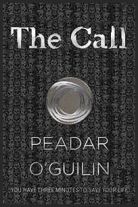
I was asked for a review and Q & A with Peadar for a brilliant new feminist website called EtymNews.  Here’s the thought provoking result:

The Call by Peadar O’Guilin: the next Hunger Games?

Looking for another The Hunger Games or Divergent?  Here’s a brilliant Young Adult novel set in a dystopian Ireland.  Imagine living in a country where every single teenager gets “The Call”.  Without warning, you are transported to the baroque horrors of the Grey Lands where the vengeful Sidhe hunt you for sport, killing you or worse.  Much worse.  The odds of surviving this ordeal are improving through intense training in special colleges and now perhaps one in ten teenagers make it back alive.  Nessa is the girl least likely to succeed with her legs twisted by polio yet she is absolutely determined to be the very best she can be.  Tension builds as we learn the horrific fate of other students as they are “Called”.  But who will be next and can Nessa and her friends make it through?

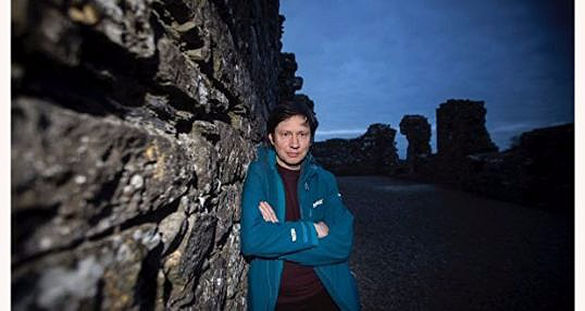
The Call was inspired by the beautiful northwest of Ireland where he grew up but now Peadar O’Guilin lives just outside Dublin.  He has written plays, published short stories, and performed as a stand-up comedian whilst holding down a day job. I tracked him down to ask him a couple of pertinent questions about the book …

Q: Why did you choose to make your main character a girl not a boy? 

A: When I first started reading, female protagonists spent their lives peeping out from between the covers in the romance section of the bookshop. Now and again, a few would make the journey over to the SF shelves, especially if the writer were somebody like C.J. Cherryh or the late, great Tanith Lee. I loved those books, but took no particular note of the character’s gender, except to think, well, the authors are female, so naturally that’s the type of character they’re going to use.

My own short-stories had a few female protagonists, but only when the story really needed one. My default, even for the bit-players, was “standard” straight, white male.  And then, one day, the internet exploded with talk of “diversity”. Back in the beginning, the definition was so limited, it was almost enough for a book to pass the Bechdel test. But even then, the debate looked to me like a lot of angry people shouting at each other and I didn’t want to be involved.

However, beneath all the passion were a few arguments that made me question what I was doing. The main ones were: 1) The world is diverse, if your stories are not diverse, you are not reflecting reality. 2) Everybody likes to see themselves in a story, so, why shouldn’t they? 3) Every book that adds to the overwhelming mass of “standard” characters lends credibility to the idea that only one type of story is valid.

At that point I decided to reverse my previous default. I would always start with a female protagonist unless the plot demanded otherwise.   And that, dear friends, is the story of how Nessa came out of the aether with two X chromosomes…

Q: Many reviewers appreciate that there’s no predictable “love triangle” in the story – though there is plenty of romance. Did you deliberately set out to break the formula?

A: I didn’t set out to break the formula. I generally don’t read the type of book that has love triangles in it. I am always more interested in the life and death tension of a story, rather than the will they/won’t they tension. It’s not that I dislike romance. I am a human being who has tender feelings now and again. When I write romance into a story, it’s usually a fantasy I’m creating for myself, that I want to believe in. Love triangles only confuse my simple soul.

Q: Did you find yourself drawing on your own experiences as a teenager as you were writing the book?

A: Very much so! I went to a boarding school when I was Nessa’s age. I took a smelly bus from the same station as hers, following much of the same route. Obviously, the idea of a refectory, of classes and a dorm, are extremely familiar ones to me as a result. I also read some dodgy love poetry and wrote lines that were far, far worse than anything she quoted!

 Peadar O’Guilin

Q: The world building includes an Ireland being shut off behind an impenetrable barrier; a terrifying yet wronged enemy; and hard choices children have to make when they are far too young.  Were you ever conscious when writing of exploring your country’s recent past, or are the roots all in Irish mythology?

A: I am very conscious of history.   We Irish have seen both sides of colonialism. We were colonised, but in Scotland, and in North America, we were also colonisers. The famous US general, Sheridan, often misquoted as saying “The only good injun’s a dead injun”, was of Irish stock. Almost every human being alive today lives where they do because their ancestors drove out somebody else. The fact that the concept is right there in the Book of Conquests is just a reflection of how long we have been doing this to each other.  Ethnic cleansing is a horrible practice that I hope we are starting to grow out of. But the consequences live on a long time after the crimes, and in a way, that’s what my book is about.

Peadar O’Guilin has written an intense and thrilling story which is definitely my favourite Young Adult novel of the year so far.  With a deft touch, Peadar builds very genuine, complex characters with a great deal of humour and humanity. I loved Nessa: her unfailing determination, her unflinching honesty about her condition, her fierce friendships and, ultimately, her strength of purpose which shines through at the tremendous climax.

So, with the nights drawing in … why not treat yourself to a fresh, thought provoking, and really scary story?

David Fickling Books; 01 Sep 2016; Hardback; £10.99
Website Powered by WordPress.com.

Up ↑